
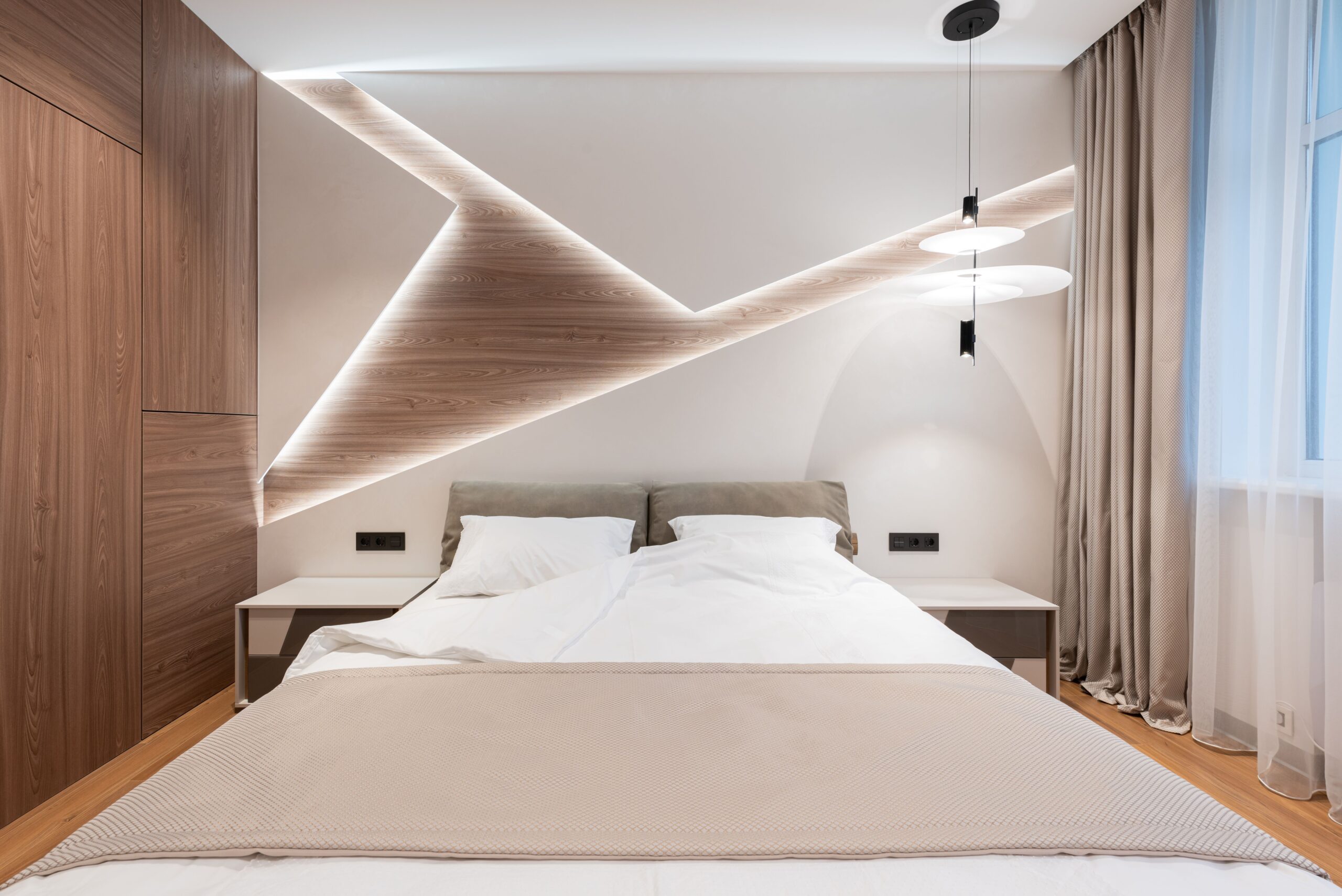
Most bedroom renovation conversations in India begin and end with the same set of decisions. The wall colour. The wardrobe finish. The bed frame. The flooring. Lighting enters the conversation late, is resolved quickly with a ceiling fixture and a couple of bedside lamps and is never discussed again. The renovation is completed, the bedroom looks acceptable, and the homeowner moves in and wonders why the room never quite feels the way the reference images did. The materials are the same. The colours are close. The furniture is right. But something is consistently off in a way that is difficult to name.
Almost always, what is off is the lighting.
Lighting is the single design element in a bedroom that affects every other element simultaneously. It determines how the wall colour looks at different times of day. It determines whether the timber of the wardrobe looks warm and rich or flat and dull. It determines how the bedding reads, whether it looks plush and inviting or simply present. It determines how the person in the room looks, whether the light is flattering or harsh. And it determines how the room feels, whether it creates the conditions for rest and restoration that a bedroom is designed to provide, or whether it simply illuminates a space for functional purposes and leaves everything else to chance.
The difference between a bedroom that looks good in photographs and one that feels right to live in is, more often than not, the difference between a bedroom with considered lighting and one without it. And the specific decisions that produce considered bedroom lighting are not complex, not expensive in proportion to their impact and not dependent on any particular design style or aesthetic direction. They are decisions about light sources, colour temperature, placement and control that apply equally to a minimal contemporary bedroom and to a warm traditional one.
At LifeSpace Interiors & Decors, lighting design is integrated into every bedroom project from the planning stage rather than being resolved at the specification stage as an afterthought, because the difference it makes to the finished quality of the room is too significant to treat it as secondary.
Why the Default Indian Bedroom Lighting Fails
The default bedroom lighting in most Indian homes consists of a single ceiling fixture, typically a surface-mounted LED panel or a flush ceiling light, positioned in the centre of the ceiling. It is either on or off. When it is on it illuminates the entire room at a single level of intensity. When it is off the room is dark. There is no middle state, no transition between the brightness of full occupancy and the darkness of sleep and no way to use the room at the range of light levels that different activities and different times of day require.
This single-source, centre-ceiling approach fails the bedroom for several specific reasons that compound each other.
The first failure is uniformity. Light distributed evenly from the centre of the ceiling eliminates the shadow and depth that the human visual system reads as spatial interest. A room lit this way looks flat in a way that no amount of texture, colour or material can fully compensate for, because the lighting is actively working against the depth that those elements are trying to create. A wall with a beautiful textured finish looks flat under uniform overhead lighting. The same wall lit with a source that rakes across its surface at an angle reveals every detail of the texture and becomes a genuinely striking visual element.
The second failure is colour temperature. Most ceiling LED fixtures installed in Indian bedrooms are cool white, in the 4000K range or above, because cool white LEDs are the most widely available and the most commonly specified by electricians without design input. Cool white light in a bedroom is actively counterproductive. The blue spectrum component of cool white light suppresses melatonin production, signals wakefulness to the brain and makes the conditions for falling asleep harder to achieve. In a room whose primary purpose is rest, the standard lighting specification is working against the room’s function at a physiological level.
The third failure is inflexibility. A bedroom that cannot transition between a brightly lit functional environment and a warmly lit atmospheric one through a simple control adjustment is a bedroom that serves one mode of use and neglects all others. The bedroom needs to be brightly lit enough for getting dressed, applying makeup and reading in the morning. It needs to be at a low, warm level for the hour before sleep when the body’s wind-down process benefits from low light intensity. It needs to provide a dim ambient glow for the brief functional activities that happen in the night without fully waking the occupant. A single overhead light on a simple on-off switch serves none of these modes adequately.
The Three-Layer Approach That Transforms a Bedroom
The lighting approach that produces the quality of environment a bedroom deserves is not complex. It is the same layered approach that transforms every interior space from flat to considered, applied specifically to the needs and activities of a bedroom.
The ambient layer is the primary level of light that allows the bedroom to function for general activities. In a bedroom, this layer should be warm-toned, on a dimmer and positioned to distribute light across the ceiling and walls rather than concentrating it in the centre of the room. Recessed downlights arranged around the perimeter of the ceiling rather than in a central cluster, a chandelier or pendant on a dimmer, or concealed cove lighting that washes the ceiling with reflected light all create ambient conditions that are more flattering, more atmospheric and more adjustable than a single central fitting.
The task layer provides directed light for specific activities that require higher intensity at specific locations. In a bedroom, the primary task lighting requirement is at the bedside for reading. A wall-mounted reading light on each side of the bed, positioned at the correct height to illuminate the reading surface without creating glare for a partner who is sleeping, or a bedside lamp with a shade that directs the light downward rather than diffusing it across the room, provides the task lighting the bedroom needs without requiring the ambient layer to be at a brightness level that serves reading but is uncomfortable for anything more restful.
The accent layer provides low-level light that creates atmosphere, defines spatial character and allows the bedroom to function at a minimal light level for the brief nighttime activities that don’t require the ambient layer to be switched on. Concealed LED strips running along the base of the bed platform, behind a floating bedside panel or along the cornice line of the ceiling create a warm glow that adds depth and atmosphere at a level of intensity that doesn’t interfere with sleep readiness. A small table lamp on a credenza or a picture light above artwork provides similar accent-level illumination in specific zones of the room.
The combination of these three layers, each independently controllable and each adjustable in intensity through dimmer controls, gives the bedroom the full range of lighting conditions it needs to support every activity and every time of day without a single fitting change. The same room can shift from brightly functional at seven in the morning to warmly atmospheric at ten in the evening to almost dark at midnight with the sleeping occupant reaching for a glass of water, simply through the adjustment of existing sources rather than any physical change to the room.
At LifeSpace Interiors & Decors, this three-layer approach is the standard for every bedroom lighting design we develop, because the transformation it produces in the quality and versatility of the bedroom environment is immediate, significant and available at a cost that is modest relative to the total investment in the room. Explore our design visualization services to see how bedroom lighting is simulated in 3D at the design stage so that clients can see exactly how their lighting specification will affect the atmosphere of their finished bedroom before any electrical work begins.
Colour Temperature: The Single Most Important Lighting Decision
If only one lighting decision in a bedroom could be made correctly, it should be the colour temperature of every light source in the room. Everything else, the number of sources, the placement, the dimmer controls, all of it serves the quality of the light. Colour temperature determines the character of that light at the most fundamental level.
Warm white in the 2700K to 3000K range is the correct specification for bedroom lighting in every application and for every aesthetic direction. This is not a style preference. It is a physiological fact. The warm end of the visible light spectrum, the amber and yellow tones produced by 2700K sources, supports the body’s natural preparation for sleep by avoiding the melatonin-suppressing blue spectrum that cooler light temperatures contain. A bedroom lit with 2700K sources feels more restful to be in not because of a design convention but because the body responds differently to warm light than to cool light at a level that is below conscious preference.
Warm white light also makes materials and surfaces look better in a bedroom. Timber surfaces look richer and warmer under 2700K than under 4000K. Textile surfaces, the bedding, the curtains, the rug, look more plush and more inviting. Skin tones look more flattering. The overall effect of a bedroom lit with consistently warm sources is an environment that looks and feels more expensive than it is, because the quality of the light is elevating the appearance of every material it touches.
The consistency of colour temperature across all sources in the bedroom is as important as the temperature itself. A bedroom where the ceiling fixture is 4000K, the bedside lamps are 3000K and the accent LED strip is 2700K has a fragmented quality that is immediately perceptible even to people who can’t identify what is causing it. All sources in the bedroom should be specified at the same colour temperature, and that temperature should be in the 2700K to 3000K range without exception.
Bedside Lighting: The Most Used and Most Important Detail
The bedside lighting in a bedroom is the lighting that is used most frequently and most directly experienced from the most important position in the room, lying in bed. Getting it right has a disproportionate impact on the daily experience of the bedroom relative to any other lighting decision, and getting it wrong is a persistent and daily irritation that no other design quality can compensate for.
The specific requirements for bedside lighting in a bedroom designed for genuine quality are: warm colour temperature, a source positioned to illuminate the reading surface without creating glare for a sleeping partner, a switch accessible from the lying position without requiring the occupant to get up or reach uncomfortably, and sufficient intensity for reading while being adjustable to a low level for the pre-sleep period.
Wall-mounted reading lights are the most effective solution for meeting all of these requirements simultaneously. A wall-mounted light fixed at the correct height, typically 900mm to 1000mm above the mattress surface, on an articulated arm that can be directed precisely at the reading surface, with a switch on the fitting body and a dimmer in the circuit, provides exactly the lighting quality that a well-designed hotel room provides at every bedside. It keeps the bedside table surface clear of lamp bodies and shades, which is a practical advantage in a room where the bedside surface is already in demand for water, a book, a phone and the other items that accumulate there.
Bedside lamps, the more common alternative, work well when specified correctly. A lamp whose shade is opaque on the back face toward the partner and translucent on the front toward the reader creates directed task light without room-flooding diffusion. A lamp on a dimmer-switched circuit provides the intensity adjustability that the pre-sleep period requires. And a lamp tall enough that the bottom of the shade is at eye height when sitting up in bed ensures that the light source itself is not in the direct sightline of either the reader or the partner.
The control of bedside lighting from the lying position extends ideally to the control of all other lights in the bedroom. A bedside panel that allows the occupant to switch off the ambient ceiling light, adjust the accent lighting and control the bedside reading light without getting out of bed is the standard that hotel rooms provide and that home bedrooms should aspire to, because the small convenience of not having to get up to turn off a light is experienced every single night and its absence is a daily minor frustration that accumulates over years.
The Effect of Lighting on Every Other Design Element
The reason lighting transforms a bedroom more than any other design element is not only that it creates atmosphere in its own right. It is that it changes the appearance of every other design element in the room, and it does so differently depending on the quality of the light, the position of the source and the colour temperature of the output.
The wall colour that was chosen under natural light in the afternoon will look different under 2700K artificial lighting in the evening and different again under 4000K ceiling lighting at night. A homeowner who specifies their wall colour under natural light and installs cool white ceiling lighting will experience a wall colour that never quite looks the way it did in the decision-making context. The same homeowner who installs warm white ceiling lighting will find that the wall colour looks consistent between the natural light conditions under which it was chosen and the artificial light conditions under which it is experienced every evening.
The timber of a wardrobe or a headboard panel looks warm, rich and three-dimensional under a warm light source that rakes across its surface at an angle. The same timber under flat, cool overhead lighting looks flat, cold and dimensionally uninteresting. The difference between the two experiences of the same material is entirely the result of lighting, and it is the reason why expensive materials sometimes look ordinary in finished rooms while modest materials look premium. The lighting is the variable that changes the reading of the material.
The bedding in a bedroom lit with warm, layered sources looks plush, inviting and expensive. The same bedding under flat, cool overhead lighting looks functional. The textured throw that adds visual depth and warmth to a well-photographed bedroom looks flat and uninteresting when the lighting doesn’t reveal its texture. The cushion arrangement that looks considered under directional warm light looks merely decorative under uniform ceiling light.
All of these differences are the result of how the lighting is designed, not of how much was spent on the materials. The right lighting specification makes ordinary materials look exceptional. The wrong specification makes expensive materials look ordinary. This is why lighting, correctly understood, transforms a bedroom more than any other single design element available.
How LifeSpace Interiors Specifies Bedroom Lighting
At LifeSpace Interiors & Decors, bedroom lighting specification begins at the spatial planning stage of every project, because the positions of electrical conduits and points need to be confirmed before walls are closed and ceilings are finished. A lighting specification developed after the room is built requires surface-mounted conduits, compromised switch positions and lighting placements that are determined by where the wiring can reach rather than where the light is needed. A lighting specification developed before any construction begins can place every source exactly where it will have the most effect.
Our standard bedroom lighting specification includes warm white sources at 2700K throughout, ambient ceiling lighting on a dimmer, wall-mounted bedside reading lights with individual switches and dimmer control, concealed accent LED strips in appropriate positions and a bedside control panel that gives the occupant full control of all room lighting from the bed.
For coastal Karnataka bedrooms where the salt air and high humidity of the coastal climate affect the long-term performance of fittings with exposed metal components, we specify indoor LED fittings and switching systems with appropriate IP ratings and finishing specifications for the moisture conditions of this environment.
See how our turnkey projects handle bedroom lighting and electrical specification as an integrated element of the complete bedroom design from the initial planning stage through to the final commissioning of the lighting system.
The Practical Steps to Better Bedroom Lighting
For homeowners who are not undertaking a full renovation but want to improve the lighting in an existing bedroom, the practical steps are straightforward and achievable without major construction.
Replacing cool white bulbs with warm white equivalents in every existing fitting is the most immediately impactful change available. The cost is negligible and the effect on the atmosphere of the room is immediate and significant. Every bulb in every fitting in the bedroom should be 2700K. This single change, made in an afternoon, transforms how the room feels in the evening more than any furniture change or decoration update could.
Adding bedside lamps if they are not already present, or replacing inadequate bedside lamps with ones that are correctly specified for their position and function, is the second most impactful practical change. A bedside lamp with a warm white bulb, an appropriate shade and a switch on the fitting body, on each side of the bed, creates the intimate bedside lighting that the room’s primary function demands.
Installing a dimmer switch on the main ceiling circuit, if the existing switch is a simple on-off toggle, adds the ambient light adjustability that is one of the most practically valuable lighting improvements in any bedroom. A dimmer on the main circuit, combined with the bedside lamps for low-level reading and pre-sleep light, gives the bedroom the full range of lighting conditions it needs without any additional fittings.
Adding a concealed LED strip in a simple location, along the base of the bed platform if it is freestanding or along the top of a low credenza or headboard panel, is the accent layer addition that requires the least construction intervention and produces the most atmospheric effect. A warm white LED strip, dimmed to a low level, creates the glow that transforms a bedroom from a room with lights in it to a room with atmosphere.
Contact our team to discuss your bedroom lighting project, whether as part of a full bedroom renovation or as a focused lighting improvement to an existing room, and we will walk you through the specific changes that will have the most impact in your specific space.
You can also browse our completed residential projects to see how bedroom lighting is integrated into the overall design quality of the spaces we design and deliver.
Conclusion
Lighting transforms a bedroom more than any other design element because it changes everything else simultaneously. The appearance of the wall colour. The richness of the materials. The quality of the textiles. The atmosphere of the space. And the physiological conditions for the rest and restoration that the bedroom is designed to provide. The decisions that produce this transformation are specific, learnable and achievable at a range of budgets: warm colour temperature in every source, three-layer distribution of ambient, task and accent light, independent dimmer control of each layer and bedside lighting that can be used and controlled from the lying position. None of these decisions is technically complex. All of them are consistently missed in the default bedroom lighting of Indian homes. At LifeSpace Interiors & Decors, they are the standard we apply to every bedroom we design, because a bedroom lit properly is a different experience from a bedroom merely illuminated, and that difference is felt every day.
To learn more about our full range of residential interior design services, visit our Services page or explore our PMC project capabilities to see how lighting design is managed as a primary design consideration across every residential interior project we take on.
For further reading on bedroom lighting design principles and the physiological effects of light on sleep quality, Architectural Digest India regularly features bedroom projects where lighting design is treated as a primary design investment. Asian Paints’ bedroom design guide also covers the relationship between lighting and colour in Indian bedroom environments with practical guidance on how to achieve the right conditions for both function and atmosphere.