
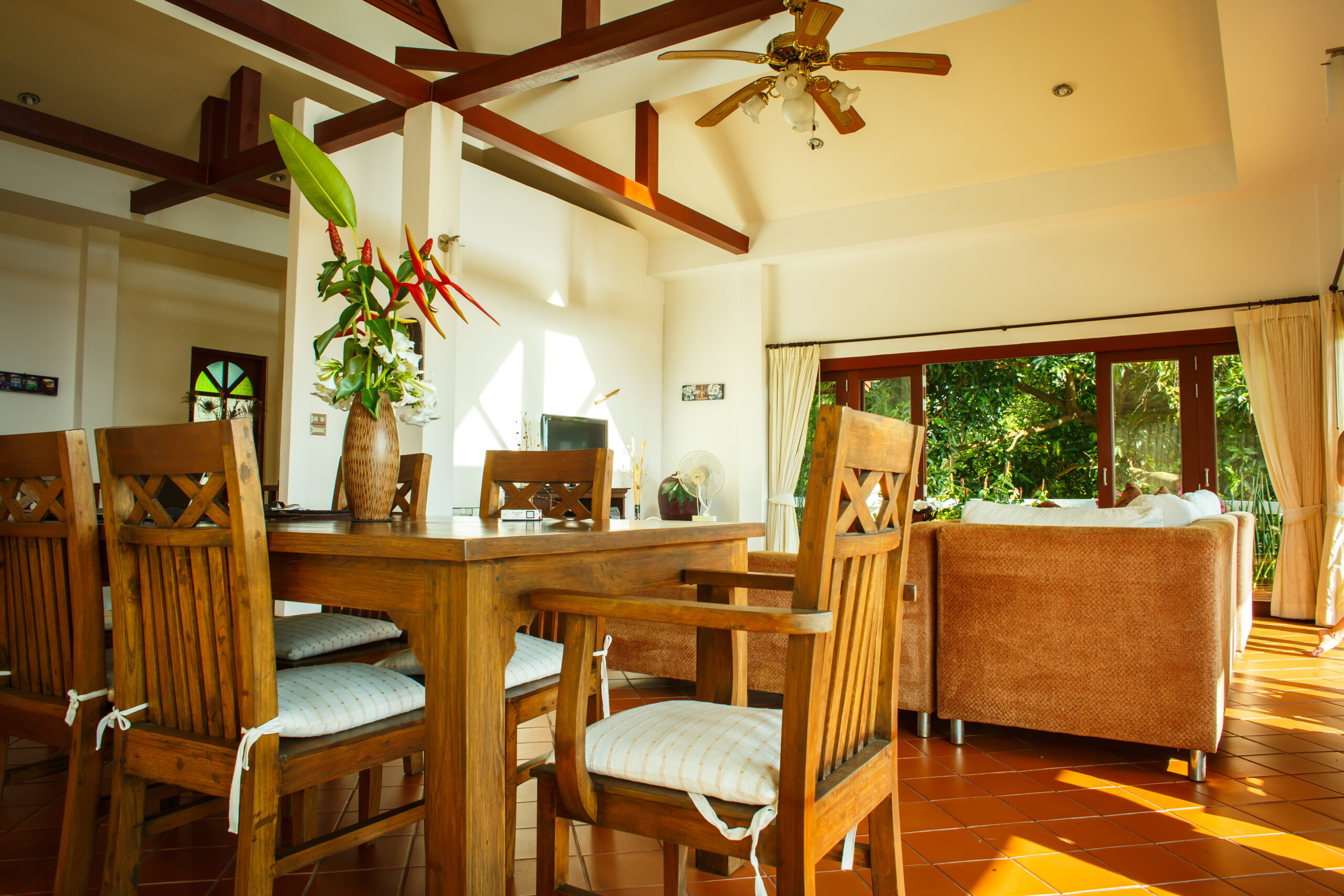
Stand in the middle of a well-designed home in coastal Karnataka on a monsoon afternoon and you understand immediately why the interior design principles that work in Bengaluru, Mumbai or Delhi do not simply transfer to this context. The light is different. The humidity is different. The relationship between inside and outside is different. The materials that perform well in a dry inland climate deteriorate in ways that are visible and sometimes dramatic in a coastal environment where salt air, extreme humidity and months of continuous rain put every surface, every joint and every material choice under stress that most standard interior specifications are simply not built to withstand.
Coastal Karnataka, the belt running from Udupi and Mangalore down through Uttara Kannada, is one of the most climatically demanding environments for interior design in India. It receives among the highest annual rainfall in the country, experiences humidity levels that remain elevated for most of the year and is close enough to the sea in many locations that salt air adds a corrosive dimension to the material challenge that inland climates don’t share. A home designed without understanding these conditions will require significantly more maintenance, more frequent replacement of finishes and fittings and more remedial work than one designed specifically for the coastal Karnataka environment from the beginning.
At LifeSpace Interiors & Decors, based in Udupi and working across coastal Karnataka, designing for this specific climate is not a specialisation we’ve developed for a niche market. It is the baseline understanding we bring to every residential and commercial project in this region, because the consequences of designing without it are visible in the homes and buildings all around us.
The Moisture Challenge: What It Does to Standard Interior Materials
The fundamental challenge of coastal Karnataka interior design is moisture, in all its forms. The monsoon brings months of continuous rain during which interior humidity levels can remain at ninety percent or above for extended periods. The pre-monsoon and post-monsoon periods maintain elevated humidity without the rain. The proximity to the sea in many coastal locations adds ambient salt to the air, which accelerates the deterioration of metal fittings, painted surfaces and certain wood species that would perform well in drier conditions.
Standard interior materials respond to this environment in predictable and damaging ways. Particleboard and low-grade MDF, the carcass materials used in most budget modular kitchens and wardrobes across India, absorb moisture through their edges and surfaces, swell, delaminate and lose their structural integrity within a few years in a high-humidity environment. The laminate or membrane finish that covers them peels at the edges as the substrate beneath it moves. The hinges and drawer slides that were specified for a dry environment corrode faster than their rated lifespan suggests. The result is furniture that looks acceptable for two or three years and begins to fail in ways that require replacement rather than repair within five.
Paint finishes that are appropriate for a dry climate blister and peel in coastal Karnataka if the wrong type is specified or if the surface preparation doesn’t account for the moisture that will work its way through walls from both inside and outside. Untreated or inadequately treated timber warps, splits and develops mould growth in ways that would not occur in the same species under drier conditions. Metal hardware, particularly in less expensive alloys, corrodes in ways that are visible within a year or two of installation.
Understanding this is the prerequisite for making material choices that perform well over the lifetime of the interior rather than looking good at handover and deteriorating steadily thereafter.
Material Selection for Coastal Karnataka Conditions
Every material decision in a coastal Karnataka interior should be evaluated against the question of how it will perform in a high-humidity, potentially salt-affected environment over ten to fifteen years, not just how it looks at the point of specification.
For joinery and furniture carcasses, BWR-grade plywood, Boiling Water Resistant, is the minimum specification. This grade of plywood is manufactured with a waterproof adhesive that maintains its bond under sustained moisture exposure, which is the fundamental requirement in a coastal Karnataka environment. At LifeSpace Interiors & Decors, we work with quality plywood from trusted brands including Greenply across all our projects in this region, because the carcass material is the foundation that everything else depends on and compromising on it in a high-humidity environment is a decision that will be regretted within a few years.
For hardware, stainless steel and quality brass fittings outperform zinc alloy and standard steel significantly in coastal conditions. Stainless steel is essentially immune to the corrosion that affects standard steel in humid, salt-affected environments. Quality brass develops a patina rather than corroding destructively. Hardware from brands like Hettich and Hafele, specified in the appropriate finish for coastal conditions, provides the performance reliability that cheaper alternatives cannot deliver in this environment.
For wall finishes, exterior-grade moisture-resistant paint on interior walls adjacent to external walls is worth specifying in coastal Karnataka homes, because the moisture that enters through external walls in a high-rainfall environment is more than standard interior paint is designed to handle. Anti-fungal additives in paint are similarly worth specifying in bathrooms, kitchens and any other areas prone to sustained humidity.
Timber in coastal Karnataka interiors needs to be species-appropriate for the humidity levels it will experience. Teak is the traditional choice for coastal Karnataka precisely because it has a natural oil content that makes it highly resistant to moisture and fungal growth. Rosewood performs similarly well. Species without this natural resistance need to be treated with appropriate preservatives and finishes to perform adequately in this environment.
Explore our furniture and decor projects to see how material specification for coastal Karnataka conditions is handled across our residential and commercial work.
Ventilation as a Design Priority
In a high-humidity environment, ventilation is not a comfort consideration. It is a building performance requirement. A home that doesn’t ventilate effectively accumulates moisture in its walls, floors and furniture, creating the conditions for mould growth, material deterioration and the musty atmosphere that characterises poorly ventilated homes in coastal Karnataka.
Traditional coastal Karnataka architecture understood this viscerally. The open verandah, the cross-ventilation through the central hall, the louvred shutters that allow air movement while keeping out rain, the high ceilings that allow warm humid air to rise and be replaced by cooler air from lower openings, all of these were design responses to the ventilation requirement of the coastal climate developed over centuries of building in this specific environment.
Contemporary coastal Karnataka homes frequently fail to incorporate these ventilation principles, sealing themselves against the monsoon in ways that trap moisture and create conditions for deterioration. A home that’s closed against the rain but not designed to ventilate effectively when the rain stops accumulates moisture problems that worsen progressively rather than resolving naturally.
The design principle for contemporary coastal Karnataka homes is cross-ventilation through every main living space, with openings positioned to take advantage of the prevailing wind direction for the region, and ceiling heights high enough to allow the stack effect, warm air rising and being replaced by cooler air from below, to work as a passive cooling and drying mechanism during the non-monsoon periods when natural ventilation is the most effective way to manage interior humidity.
At LifeSpace Interiors & Decors, ventilation strategy is addressed at the spatial planning stage of every coastal Karnataka project, because the positions of openings, the ceiling heights and the relationship between indoor and outdoor spaces all determine how effectively the home manages its own moisture environment. See how our design services approach spatial planning for coastal Karnataka homes and the specific climate considerations that inform every project in this region.
Flooring for a Coastal Climate
Flooring in a coastal Karnataka home operates under conditions that eliminate several of the options that are popular in drier climates. Solid timber flooring, which is the premium choice in much of India, is vulnerable to the humidity cycling of coastal Karnataka where the monsoon season raises humidity to levels that cause timber to expand significantly, followed by the dry season during which the same timber contracts. This cycling causes cupping, warping and joint opening in timber floors that are not adequately acclimatised and installed with sufficient expansion allowance.
Engineered timber flooring, which uses a thin layer of real timber bonded over a stable plywood substrate, handles humidity cycling significantly better than solid timber because the substrate doesn’t move as dramatically as solid wood under changing moisture conditions. It provides the visual and tactile quality of a timber floor with better dimensional stability in coastal conditions.
Stone flooring, natural or engineered, is the most dimensionally stable flooring option for a coastal Karnataka home and the most widely used in traditional and contemporary homes in this region. Granite, which is quarried locally in Karnataka, is highly durable, non-porous when sealed properly and essentially immune to the humidity and moisture challenges of the coastal climate. It requires anti-slip treatment in wet areas, where its polished surface can become hazardous when wet, but this is a standard specification for bathroom and entrance flooring in any climate.
Ceramic and porcelain tiles are equally stable in coastal conditions and are available in sizes and formats that work well in contemporary interiors. Large format tiles, 600mm by 600mm or larger, reduce grout line density which reduces the moisture retention and mould growth risk associated with dense grout networks in high-humidity environments.
The Outdoor-Indoor Relationship in Coastal Karnataka Homes
The relationship between the outdoor and indoor environments in a coastal Karnataka home is more complex and more dynamic than in most other Indian climates. The outdoor environment during the monsoon, months of heavy rain, high wind and extreme humidity, is genuinely hostile to the interior. During the dry season, the same outdoor environment is one of the most beautiful in India, with lush greenery, sea breezes and a quality of light that interior spaces should connect to as fully as possible.
Designing a coastal Karnataka home to manage this dynamic, protecting the interior during the monsoon while opening it to the outdoor environment during the dry season, requires design decisions that a house designed for a single static relationship between inside and outside doesn’t need to make.
Deep overhangs are the traditional solution and remain the most effective one. A roof overhang of 900mm to 1200mm beyond the external wall keeps rain off the external surfaces of windows and doors even in heavy monsoon rain with a horizontal wind component. It allows windows and doors to be opened in light rain without water entering the interior. And it creates the covered verandah space that is one of the most distinctive and most valuable spatial features of coastal Karnataka domestic architecture.
Sliding and folding door systems that connect living areas to covered outdoor spaces allow the indoor-outdoor boundary to be managed dynamically, fully closed during heavy monsoon rain, partially open during lighter rain and fully open during the dry season when the outdoor environment is at its most beautiful.
Colour and Light in Coastal Karnataka Homes
The quality of natural light in coastal Karnataka is distinctive and worth designing around rather than treating as a background condition. The bright, slightly diffused light of the coastal Karnataka dry season, filtered through the lush vegetation that surrounds most homes in the region, is warmer and softer than the harsher direct light of drier inland climates. This quality of light responds well to warm material tones, natural textures and the earthy ochres, terracottas and greens of the regional colour tradition.
The monsoon light is flatter, greyer and more uniform, which means interiors need to work well without the contribution of strong natural light for four to five months of the year. This argues for warm artificial lighting that compensates for the grey quality of monsoon natural light, and for interior colour palettes that hold up well under flat light rather than depending on strong sunlight to look their best.
Materials with natural texture, timber, stone, woven textiles, terracotta, perform better under flat monsoon light than smooth, reflective surfaces that need strong directional light to show their quality. A coastal Karnataka interior specified with natural materials and warm tones looks good in both dry season and monsoon conditions, which is the correct target for a home that experiences both extremes.
How LifeSpace Interiors Approaches Coastal Karnataka Projects
At LifeSpace Interiors & Decors, every project in coastal Karnataka is approached with full awareness of the specific performance requirements of this climate, because we are based in this region and we see the consequences of designs that don’t account for it in the homes and buildings around us every day.
Our material specifications for coastal Karnataka projects prioritise moisture resistance, corrosion resistance and dimensional stability over the full lifespan of the interior rather than just at the point of installation. Our spatial planning addresses ventilation and the outdoor-indoor relationship as primary design considerations rather than afterthoughts. And our execution standards require that all materials are installed correctly for coastal conditions, with the surface preparation, sealing and fixing methods that performance in this environment demands.
Contact our team to discuss your coastal Karnataka home project and we will walk you through how design for this specific climate is planned, specified and delivered to a standard that holds up over time.
You can also explore our PMC project capabilities to see how we manage coastal Karnataka residential and commercial projects from the initial brief through to the final handover.
Conclusion
Coastal Karnataka is one of the most beautiful and one of the most climatically demanding environments for interior design in India. A home designed for this environment with full awareness of its moisture, humidity, salt air and ventilation challenges will perform significantly better and require significantly less remedial work over its lifetime than one designed to standard Indian specifications without regional adaptation. The material choices, the ventilation strategy, the flooring specification, the hardware selection and the outdoor-indoor relationship all need to be addressed differently in coastal Karnataka than in drier inland climates, and the consequences of not addressing them are visible in every home in the region that has been designed without this understanding. At LifeSpace Interiors & Decors, designing for coastal Karnataka is not a specialisation. It is simply what designing for this place correctly means.
To learn more about our full range of residential and commercial interior design services, visit our Services page or browse our completed design and turnkey projects to see the quality of work we deliver across coastal Karnataka.
For further reading on designing for tropical and coastal climates in India, Architectural Digest India regularly features coastal and tropical residential projects that illustrate the design principles discussed in this guide. Greenply’s material guide is also a useful reference for understanding the performance characteristics of different plywood grades in high-humidity environments.