
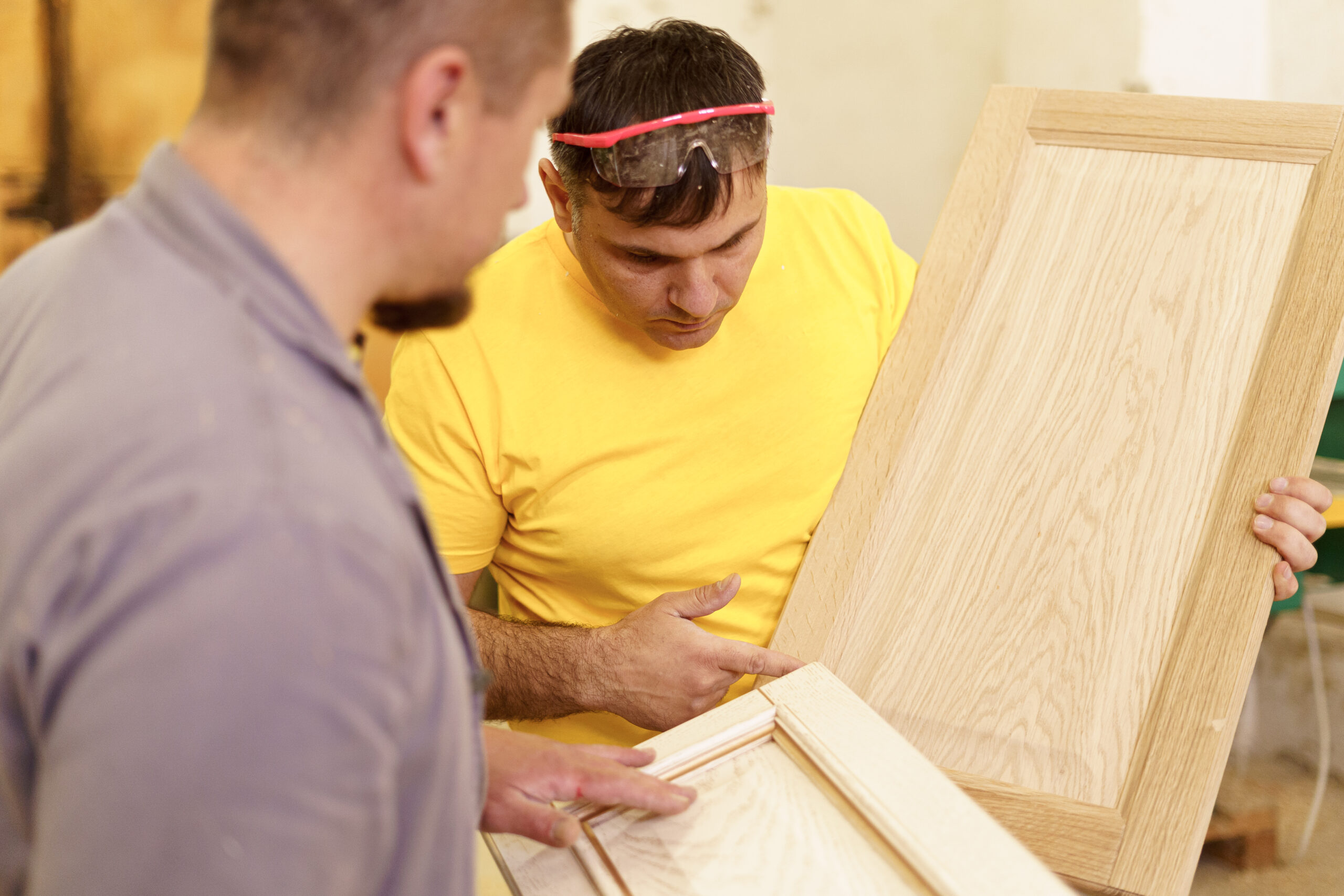
Every homeowner who has sat across a table from a carpenter or a modular furniture salesperson has heard some version of the same conversation. The carpenter recommends plywood. The modular brand uses HDF or MDF for the shutters and particleboard for the carcass. The premium brand says solid wood throughout. Everyone claims their material is the right choice and everyone has a reason that sounds convincing in isolation. The homeowner, who came in wanting a wardrobe or a kitchen and not a materials science lesson, leaves either confused or having simply trusted whoever made the most confident claim.
The confusion is understandable because the choice between plywood, MDF and solid wood is genuinely nuanced. None of these materials is universally superior to the others. Each has specific properties that make it the right choice for specific applications, and each has limitations that make it the wrong choice for others. Understanding those properties and limitations, clearly and without the commercial bias of someone who profits from one choice over another, is the most useful information a homeowner can have before commissioning any significant piece of furniture or joinery.
At LifeSpace Interiors & Decors, material specification for furniture and joinery is one of the most consequential decisions we make on every project, because the material inside a piece of furniture determines how it performs over ten to fifteen years of daily use in ways that the finish on the outside can neither predict nor compensate for.
What Plywood Actually Is and Why It Performs the Way It Does
Plywood is a panel material made from thin layers of wood veneer, called plies, bonded together with adhesive with adjacent plies oriented at right angles to each other. This cross-grain construction is the source of plywood’s most important properties. By alternating the grain direction of successive plies, the natural tendency of wood to shrink and expand along the grain is countered in each ply by the resistance of the adjacent plies, which makes plywood significantly more dimensionally stable than solid wood of the same thickness and significantly more resistant to warping, splitting and checking under changes in temperature and humidity.
The number of plies and the quality of the adhesive used to bond them determine the grade and performance of the plywood. More plies produce a panel with fewer voids and a more consistent cross-section. Quality adhesive, particularly waterproof adhesive in BWR-grade and marine-grade plywood, determines how the panel performs under moisture exposure.
Plywood’s screw-holding strength is significantly higher than particleboard or MDF of equivalent thickness, which matters for furniture applications because screws and fittings are the primary mechanism by which hardware is fixed to the carcass. A hinge fixed into plywood with the correct screw remains fixed under years of daily operation. A hinge fixed into particleboard with the same screw has less material to grip and is more likely to work loose over time, which is one of the primary mechanisms by which particleboard furniture deteriorates in ways that plywood furniture does not.
The density of plywood is lower than MDF of equivalent thickness, which makes plywood furniture lighter and easier to handle without sacrificing structural strength. The ability to cut plywood cleanly with standard woodworking tools, to machine profiles into its edges and to finish its surface to a paintable or veneerable standard makes it highly versatile across the full range of furniture and joinery applications.
For coastal Karnataka homes specifically, the moisture resistance of BWR-grade plywood, whose waterproof adhesive maintains the bond between plies under sustained moisture exposure, is the most critical material performance property in the high-humidity environment of this region. Read more about how material specification for coastal Karnataka conditions affects every joinery and furniture decision in a home designed to perform well across the full annual range of conditions this climate delivers.
What MDF Is and Where It Performs Best
MDF, Medium Density Fibreboard, is a panel material made from wood fibres that have been broken down from wood waste and bonded with resin under heat and pressure. The result is a panel with a completely uniform cross-section, no grain, no voids and a surface that is smoother and more consistent than the surface of any plywood. This surface consistency is MDF’s most significant advantage and the property that makes it the preferred material for applications where a perfectly smooth, paintable surface is the primary requirement.
The uniform, grain-free surface of MDF accepts paint with a consistency and a quality of finish that plywood and solid wood cannot match. A painted cabinet door in MDF has a smooth, consistent surface with no grain showing through the paint, which is the characteristic of a high-quality painted finish. The same door in solid wood has a grain texture that shows through the paint regardless of how many coats are applied and how carefully the surface is prepared, which is either desirable as a design element or undesirable depending on the finish specification.
MDF machines very cleanly, allowing precise routing of profiles into its surface and edges that are sharper and more consistent than the equivalent profiles in plywood. This property makes MDF the preferred material for routed door profiles, shaped edges and other decorative machining operations that require a material with no grain direction to influence the machining result.
The limitations of MDF are significant in the context of a coastal Karnataka interior. MDF absorbs moisture more readily than plywood and swells when it does, which makes it a problematic carcass material in a high-humidity environment. Its screw-holding strength, particularly at edges and faces, is lower than plywood, which means that hinges and drawer slides fixed into MDF carcasses are more likely to work loose under sustained daily use than those fixed into plywood. And its weight is greater than plywood of equivalent thickness, which makes MDF furniture heavier and more difficult to handle and install.
The correct application for MDF in a furniture and joinery context is therefore as a shutter and panel material where its smooth surface and precise machinability are the primary requirements, used over a plywood carcass that provides the structural performance that MDF cannot. This combination, plywood carcass with MDF or HDF shutters, represents the best of both materials and is the specification used in quality modular kitchen and wardrobe systems.
What Solid Wood Is and Where It Belongs
Solid wood furniture is furniture made from timber sawn directly from the log, dried to an appropriate moisture content and machined into the components of the piece without the use of adhesive-bonded panel materials. It is the oldest form of furniture construction and the one that carries the strongest association with quality, craft and longevity in the perception of most homeowners.
The association is partly justified and partly romantic. Solid wood furniture made from quality species, dried correctly, jointed with appropriate methods and finished with durable surface treatments, is genuinely the most durable and most beautiful furniture available. A solid teak dining table or a solid rosewood cabinet made by a skilled craftsperson will outlast the household that commissioned it and will improve in character as it ages in ways that no manufactured panel product can replicate.
The limitations of solid wood are equally real. Solid wood moves significantly more than plywood or MDF under changes in temperature and humidity, expanding across the grain in humid conditions and contracting in dry ones. This movement is the reason that solid wood furniture requires construction methods specifically designed to accommodate it, such as mortise and tenon joints that allow movement without distortion and floating panels that can expand and contract without causing the surrounding frame to split. Solid wood furniture constructed with panel material methods, glued up in large flat panels without provision for movement, will split, warp and check over time regardless of the quality of the wood.
For coastal Karnataka specifically, the humidity cycling of the monsoon climate creates significant dimensional movement in solid wood components that are not correctly specified and constructed for the environment. Species with high natural oil content, teak and rosewood being the most significant in the Karnataka context, handle this cycling better than drier species because the natural oil partially moderates the rate of moisture absorption and release. Species without this natural resistance require more aggressive surface treatment to perform adequately in coastal conditions.
The cost of solid wood furniture is significantly higher than equivalent furniture in plywood or MDF, both because quality timber is an expensive raw material and because the craft skills required to work it correctly are time-consuming and specialist. For applications where the aesthetic and material qualities of solid wood are essential to the design intent, the cost is justified. For applications where panel materials can deliver equivalent functional performance and the aesthetic difference is not significant, the cost premium of solid wood is not always warranted.
The Right Material for Each Application
The practical guide to material selection for furniture and joinery is not a single answer for all applications but a matching of the right material to the specific requirements of each use.
Furniture carcasses, the structural body of kitchen cabinets, wardrobes and storage units, should almost always be specified in quality plywood. The structural strength, the screw-holding capability, the moisture resistance of BWR-grade plywood and the dimensional stability under humidity cycling all make plywood the correct carcass material for the demanding conditions of daily furniture use in an Indian interior, and particularly in the high-humidity environment of coastal Karnataka.
Shutter and panel faces, the visible doors and drawer fronts that cover the plywood carcass, can be specified in MDF or HDF where a painted or lacquered finish is required, or in plywood with a timber veneer where a natural wood appearance is preferred. The choice between these depends on the aesthetic direction of the design rather than on structural performance, because the shutter is not a structural element and both materials perform adequately in this application when correctly specified and edge-sealed.
Solid wood components, where they are specified, belong in applications where the material’s natural character is the design intent: table tops, chair and sofa frames, bed frames and the structural elements of traditional-style furniture where the joinery detail and the natural beauty of the timber are visible design elements rather than hidden structural components. Solid wood in these applications, from the right species and constructed with the right methods, is genuinely the best material available and worth the cost premium it commands.
Internal shelving and fixed horizontal panels within carcasses can be specified in plywood or in particleboard, depending on the load they will carry and the humidity conditions they will experience. In a kitchen or bathroom, BWR plywood is the correct specification for internal shelving because the humidity exposure is significant. In a wardrobe in a dry, air-conditioned bedroom, quality particleboard shelving may be adequate for light clothing loads, though plywood is still the more durable specification.
At LifeSpace Interiors & Decors, material specification for every furniture and joinery project is made with full awareness of the specific application, the specific environmental conditions and the specific performance requirements of the finished piece. We work with quality materials from trusted brands including Greenply for plywood carcasses, because the foundation material of every piece of furniture we deliver is not a procurement decision to be made on price alone but a quality decision that determines how the furniture performs over its full operational life. Explore our furniture and decor projects to see how material specification is integrated into the design and quality standard of every piece of furniture we produce.
The Particleboard Question
No guide to furniture materials in the Indian context is complete without addressing particleboard, which is by far the most widely used furniture carcass material in the Indian market despite being the lowest performing under the conditions that Indian homes typically impose.
Particleboard is made from wood chips and sawdust bonded with resin under pressure. It is the cheapest panel material available, which is why it dominates the budget and mid-range modular furniture market in India. Its limitations in a demanding interior context are significant: low screw-holding strength that allows hardware fixings to work loose under sustained daily use, high moisture absorption that causes swelling and delamination in humid environments and a structural integrity that deteriorates progressively rather than maintaining its initial performance.
In a dry, air-conditioned environment with light daily use, particleboard furniture can perform adequately for five to seven years before its limitations become visible. In the humid, demanding conditions of a coastal Karnataka home, that lifespan is significantly shorter. In a kitchen, where the combination of heat, steam, moisture and heavy daily use puts the carcass material under continuous stress, particleboard is the wrong specification regardless of how attractive the shutter finish is.
The price difference between a particleboard carcass and a quality plywood carcass in a modular kitchen or wardrobe is real but modest relative to the total cost of the furniture. The performance difference over the operational life of the furniture is significant enough to make plywood the clearly correct choice for any homeowner who is making a long-term investment rather than a short-term purchase.
What to Ask Your Carpenter or Modular Supplier
Armed with the information in this guide, a homeowner approaching a carpenter or modular furniture supplier for a kitchen or wardrobe project has specific questions to ask that will clarify the material specification being proposed and allow a genuine comparison between competing quotes.
What is the carcass material and what grade? BWR plywood is the correct answer for kitchen and bathroom applications. Any answer involving particleboard or standard interior-grade MDF for a kitchen in a coastal Karnataka home is a specification that should be questioned.
What is the shutter material and how are the edges sealed? The edge sealing of shutters is as important as the face material in a high-humidity environment, because unsealed edges allow moisture entry that degrades the shutter from the inside regardless of the quality of the face finish.
What hardware brand and product system is being specified for the hinges and drawer slides? Hettich and Hafele are the quality benchmarks for this application. A quote that specifies unknown or generic hardware brands is a quote that is saving money on the component that most directly determines the operational performance of the furniture over time.
What is the warranty on the furniture and what does it cover? A manufacturer or carpenter confident in their material specification will offer a meaningful warranty. A vague or short warranty on a significant furniture investment is worth questioning before the contract is signed.
Contact our team to discuss your furniture or joinery project and we will walk you through exactly what material specification we propose, why we propose it and how it compares to the alternatives available at different price points.
You can also explore our completed residential and commercial projects to see the standard of material specification and finish quality we bring to every furniture and joinery project we take on.
Conclusion
Plywood, MDF and solid wood are three different materials with three different sets of properties that make each of them the right choice for specific furniture applications and the wrong choice for others. Plywood is the correct structural material for furniture carcasses in Indian interiors, particularly in the demanding conditions of coastal Karnataka where its moisture resistance and screw-holding strength are essential performance properties. MDF is the correct material for painted and profiled shutter faces where surface consistency is the primary requirement. Solid wood is the correct material for visible structural and decorative components where the natural character of timber is the design intent. Understanding this distinction, and applying it to the furniture decisions that determine how a home interior performs over ten to fifteen years of daily use, is one of the most practically valuable things a homeowner can do before commissioning any significant piece of furniture or joinery. At LifeSpace Interiors & Decors, this material intelligence is the foundation of every furniture specification we make, because furniture built from the right materials in the right applications is furniture that delivers on its promise across the full operational life of the interior it serves.
To learn more about our full range of residential and commercial interior design and furniture services, visit our Services page or explore our turnkey project capabilities to see how material specification is integrated into the complete design and execution process we bring to every interior project.
For further reference on wood-based panel material specifications and performance characteristics, Greenply’s technical product guide covers the full range of plywood grades and their appropriate applications in residential and commercial interior projects. Architectural Digest India also regularly features furniture and joinery projects that illustrate how material choices at the specification stage determine the quality and longevity of the finished result.